
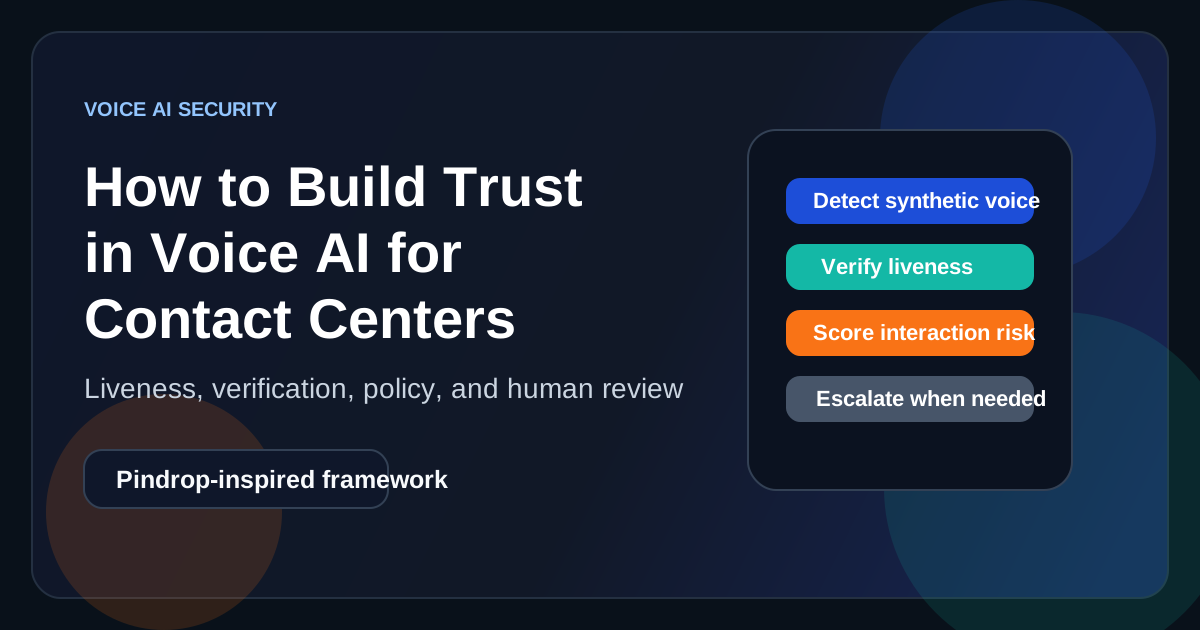
Voice AI is becoming more capable in support, banking, insurance, healthcare, and sales workflows. That creates a simple challenge for contact centers: if AI can talk more like a real person, how do you know when an interaction is safe to trust?
Pindrop's public research is useful here because it treats trust as an operational problem, not a branding slogan. In practice, building trust in voice AI means proving that the caller is real, understanding the risk of the interaction, and making sure sensitive actions do not move forward on weak evidence.
Why trust is becoming a bigger problem
The old model assumed that most callers were human and that fraud checks could sit later in the flow. That is much weaker now. Synthetic voice tools can clone tone, cadence, and emotion well enough to make phone-based impersonation more scalable.
Pindrop reported that deepfake call activity rose sharply through 2024, and that trend is exactly why contact centers need stronger verification systems. If the channel can be imitated, then trust has to be earned through signals, not assumed by default.
1. Start with liveness detection
A contact center should not jump straight to account actions before it has some confidence that the voice on the line is live and human. Liveness detection is one of the most important control points because it answers a more basic question than identity: is this even a real human interaction?
That is where trust starts. If a business skips this step, every downstream check is working on top of weak assumptions.
2. Detect synthetic or manipulated audio early
Trust in voice AI depends on early detection. The longer a fake interaction stays untreated, the more likely it is to reach an agent, trigger an account workflow, or pressure a human into approving something risky.
Detection should happen before high-value steps such as password resets, account recovery, payout requests, address changes, or sensitive support actions. The earlier the system can score synthetic voice risk, the safer the workflow becomes.
3. Use layered trust signals
One signal is not enough. Trusted voice AI systems should combine multiple inputs such as audio risk, behavioral patterns, device indicators, historical account context, and workflow sensitivity.
This layered model is important because attackers often beat the weakest single check. A stronger design asks several questions at once:
- Does the voice appear synthetic or replayed?
- Does the request match the account history?
- Is the caller behavior normal for this workflow?
- Is the requested action low risk or high risk?
4. Keep humans in charge of sensitive decisions
Voice AI can save time, but trust falls apart when automation is allowed to complete sensitive actions on weak confidence. Payments, identity changes, account recovery, and unusual requests should have clear escalation rules.
The goal is not to block AI. The goal is to make AI useful within boundaries. Contact centers that do this well let automation handle routine flows and require human review when the trust score drops or the action value rises.
5. Make decisions explainable
A trustworthy system should be able to explain why an interaction was accepted, flagged, or blocked. That does not mean exposing every model detail to the caller. It means giving operations, fraud, and compliance teams a clear reason trail.
Explainability matters because contact centers need to tune policies, investigate incidents, and show that trust controls are working. If the system cannot explain its decision path, the team will struggle to improve it.
6. Build policy around risk, not only speed
Many AI deployments focus on average handle time, containment, and efficiency. Those metrics matter, but they are incomplete without trust metrics. A better approach is to pair efficiency goals with security goals such as synthetic voice detection rate, escalation quality, and false-accept risk.
This is where many organizations need a mindset shift. The fastest contact center is not the best one if it gets fooled by convincing synthetic callers.
What good looks like
A strong voice AI trust model usually has these traits:
- Real-time liveness or deepfake screening at the start of the call
- Risk scoring that changes as the interaction evolves
- Policy gates for high-risk actions
- Human review for exceptions and sensitive workflows
- Clear audit trails for accepted and challenged interactions
Final thoughts
Building trust in voice AI for contact centers is not mostly a UX problem. It is a verification problem. The more realistic synthetic voice becomes, the more important it is to prove liveness, combine signals, and slow down risky actions at the right moment.
Pindrop's research points in the right direction: trust should be designed into the workflow from the first second of the interaction. When contact centers do that well, AI becomes faster and safer at the same time.
Sources
Pindrop: Agentic AI Fraud Detection - Why It's the Future of Enterprise Security
Pindrop: Deepfake Fraud Could Surge 162% in 2025
Pindrop and NiCE Partner for Native Voice Authentication and Fraud Detection in CXone